
Kaiserswerth – Past and Present
Kaiserswerth, Düsseldorf's oldest district: 1300 years from Suitbertus and the Barbarossa palace to Fliedner's Diakonie, plus historic postcards 1895–1935.
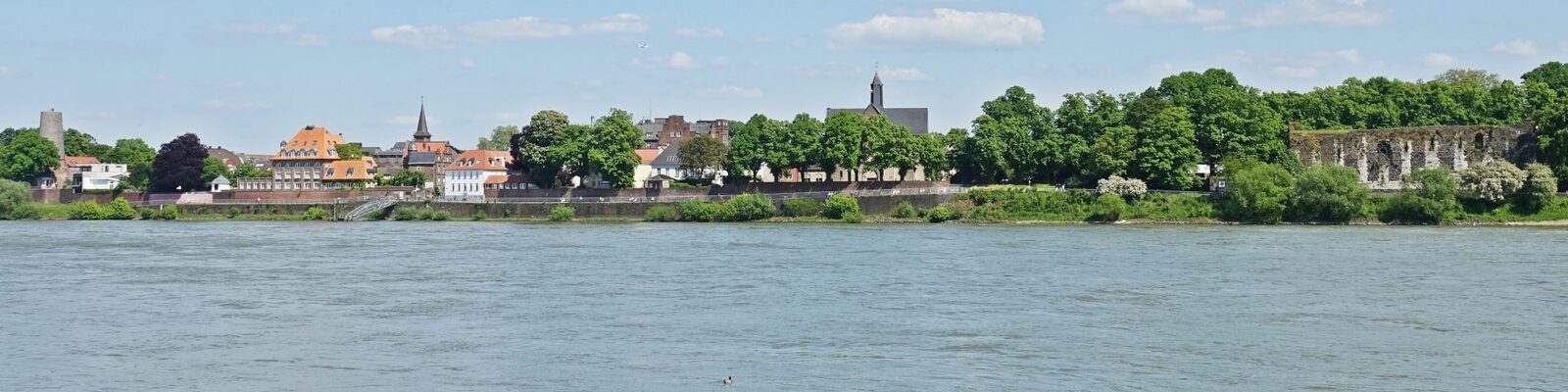
Kaiserswerth today in a nutshell
Kaiserswerth lies in the north of Düsseldorf, right on the Rhine. Kaiserswerth is more than 1300 years old, making it the oldest district of Düsseldorf, and it impresses with its historic centre, the imperial palace (Kaiserpfalz) and the Rhine promenade.
Kaiserswerth has a village-like charm and is a popular destination for day trips, not least because of its idyllic surroundings. The district is a sought-after residential area in the north of Düsseldorf.
Your favourite places in Kaiserswerth
This section is still under construction.
Here we would like to show photos and descriptions of particularly beautiful places in the north of Düsseldorf.
We would therefore be delighted to show and publish your favourite places in today's northern Düsseldorf here on this page.
You can find further information here.
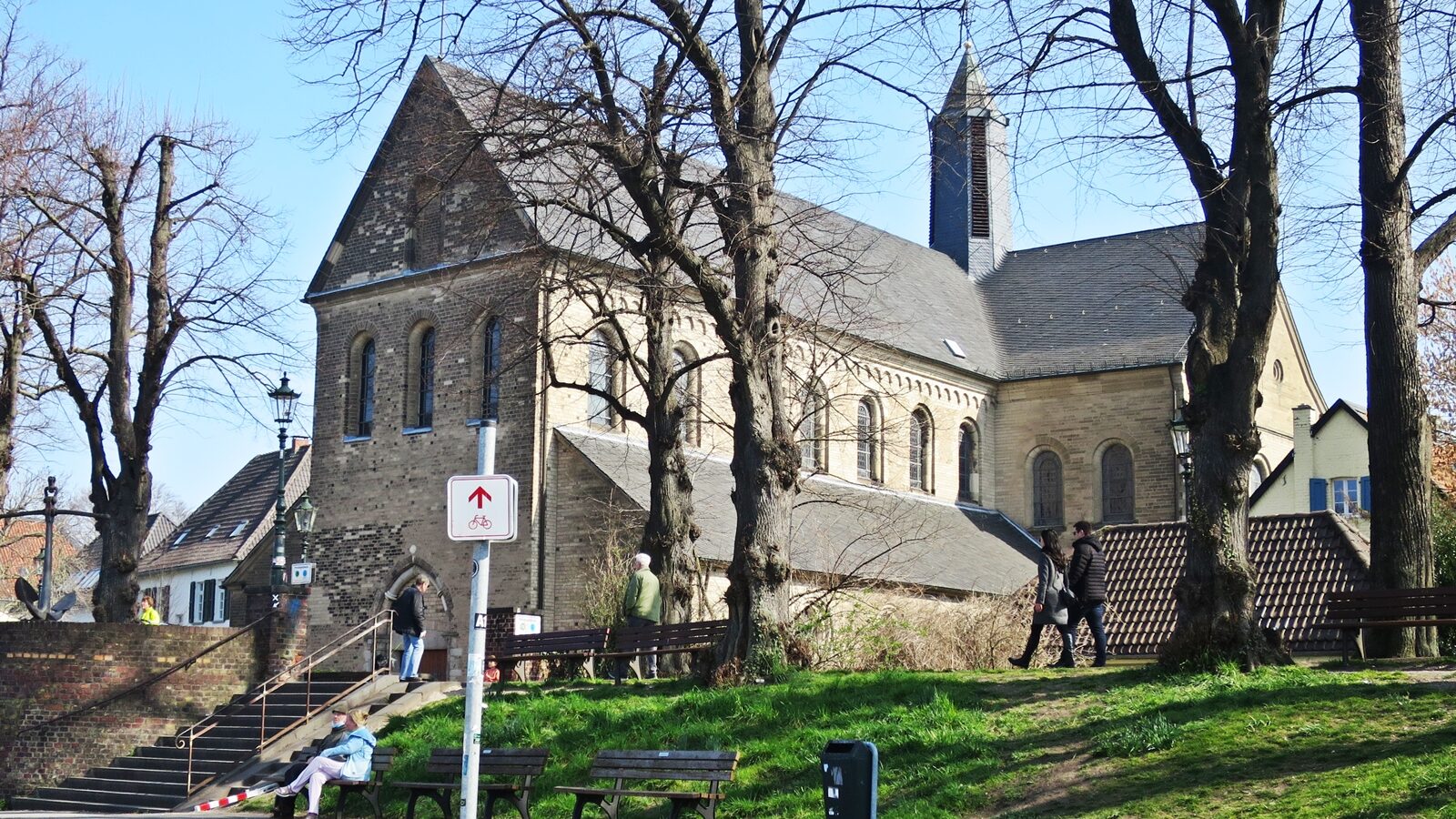
My favourite little spot in Kaiserswerth
by Heinrich Sövegjarto
There is no debate about it: the area around the anchor is not only my favourite little spot, but also that of many Kaiserswerth residents, their guests and day-trippers. It is no coincidence that there are more benches here, on and above the Rhine promenade and on the castle rampart, than anywhere else. If these seats are not enough, you can sit quite comfortably on the flood-protection wall or on the steps next to the towing stone (Treidelstein).
The sunsets here are the most impressive, in every shade of yellow and red depending on the clouds, or when rays of sunshine break through gaps in the clouds. Now and then a jet climbs above or through the clouds on its way out into the wide world. A reason to dream. Sometimes the Rhine glistens in the sunlight, sometimes it flows by grey, murky and sluggish, sometimes in bright blue, sometimes with little white crests of foam. Usually it is busy with cargo ships and river cruise ships. A touch of Blankenese! It can be eerie in the early morning, when light mist still hangs over the opposite bank.
On sunny summer weekends, the promenade below the anchor is as busy as the Kö.
Sitting on my favourite bench, looking west across the Rhine and into the wide sky, the venerable basilica rises behind me, to the left the ruins of the imperial palace, and to the right behind me the historic, tranquil Stiftsplatz invites you in.
In the evening and well into the night, however, the anchor is also a meeting point for youth groups, some of them quite large. When school-leavers have put the "exam pressure" behind them in early summer, this can spread along the whole castle rampart. For residents of Stiftsplatz who are used to peace and quiet, this may sometimes be too much and too loud. But they would not think of moving away from here, from the historic core, the heart of Kaiserswerth.
The history of Kaiserswerth
Kaiserswerth's history in brief
The name Kaiserswerth derives from the Middle High German word werth, meaning island; it therefore means "emperor's island" or "island of the emperor".
Kaiserswerth has a rich history that is reflected in its topography and its historic monuments.
- Foundation of a monastery by Suitbertus at the end of the 7th century
- Salian and Staufer imperial palace in the 11th and 12th/13th centuries
- Collection of Rhine tolls
- Important Electorate of Cologne fortress in the 17th century
- Silk-weaving manufactories at the end of the 18th century
- Foundation of the Diakonie (deaconess institution) by Theodor Fliedner in the 19th century
Kaiserswerth's history in more detail
The area of today's Kaiserswerth was already settled in 5000 BC.
Here you can read a short version of the history of Kaiserswerth.
Before Suitbertus came (before AD 700)
The oldest known man-made structure in our region is the menhir (Celtic: long stone) at the corner of Alte Landstraße and Zeppenheimer Weg. Historians believe it was erected as early as the Bronze Age (from around 2000 BC). In Celtic and Germanic times there was certainly a place of worship here, an assembly (thing) site and/or a place of judgement. As a counterpart to this pagan site, St. George's Chapel was built opposite it in AD 1078. It had to make way for the expansion of the fortifications in 1688. Until the beginning of the 19th century, justice was still administered a few metres further north (Alte Landstraße 223), first before a Vehmic court or high court and finally before the Bergisches Landgericht (regional court of the Duchy of Berg).
Our ancestors liked to settle on the banks of the Rhine and on islands in the river, partly because of the abundance of fish and partly for protection from wild animals and enemies.
There are many archaeological finds in the Kaiserswerth area from the Iron Age (1400 BC – AD 400) and from the Germanic-Frankish-Roman period (first half of the 1st millennium AD). Here the Rhine formed the border between the Germanic tribes and the Roman Empire (Lower Rhine Limes).
From Suitbertus' Benedictine monastery to the canons' foundation (700 – 1045)
Kaiserswerth enters written history with the bishop and missionary Suitbertus (c. 645 – 713), who came from England. Under the protection of a Frankish royal estate, he founded a church dedicated to St. Peter and a Benedictine monastery at the end of the 7th century. By the 9th century at the latest, this had become a foundation of canons (Kanoniker-Stift). The foundation's immunity was repeatedly confirmed by German emperors in charters (877 and 888). The great importance of the Kaiserswerth foundation within the "Holy Roman Empire of the German Nation" is also shown by the fact that it was headed by lay abbots of high nobility. One of them, Conrad the Younger, became German king in 911.
The kings and emperors governed the empire, which at its greatest extent finally reached from the Elbe to Sicily, by travelling with their retinue (400 people or more) from royal estate to royal estate or palace. There the local princes would gather, and charters were sealed (drawn up and signed).
The foundation was dissolved in 1803 in the course of the Napoleonic secularisation. The basilica, whose present choir still dates from the 13th century (with foundations from even earlier), became the Catholic parish church. The relics of Suitbertus, venerated as a saint since the 9th century, and of his companion Willeicus lie in a gilded shrine in the church.
Imperial residence (palace) in Kaiserswerth (1045 – end of the 14th century)
Directly next to the canons' foundation, the Salian emperor Henry III (1016 – 1056) had a palace (Pfalz) built around 1045. Today only foundations remain beneath the town park (between the Suitbertus-Gymnasium and the ruins of the Staufer palace). They were documented by the state conservator Paul Clemen between 1898 and 1908. After the early death of Henry III, his widow Agnes of Poitou stayed in Kaiserswerth with their son Henry IV, who was still a minor. At Whitsun 1062, the 12-year-old Henry IV (1050 – 1106), already elected king, was abducted from the palace in a spectacular kidnapping by Archbishop Anno of Cologne and his helpers. They wanted to influence his upbringing and the exercise of power in the empire. After coming of age, Henry IV challenged the supremacy of the popes. Excommunicated by the pope, he had to make the famous "Walk to Canossa" (where the pope was staying at the time) in 1076.
The Staufer emperor Frederick I, known as Barbarossa (c. 1122 – 1190), had a new palace built from 1173, of which today's ruins remain. To finance it, he moved the Rhine toll from Tiel in Holland to Kaiserswerth. Urban structures had already developed in Kaiserswerth before this. Conrad III had granted Kaiserswerth Aachen town rights in 1145 and exempted Kaiserswerth's merchants from tolls. Henry VI confirmed these privileges in 1194.
During these centuries (11th – 14th), Kaiserswerth flourished as a royal and imperial, independent imperial city. (Note: the kings elected by the German princes became emperors when crowned by the pope.)
The trade of Kaiserswerth's merchants flourished. The toll, a ferry and a towing station brought income into the town. In 1181 the merchants' settlement was extended eastwards as far as the Fleeth (a branch of the Rhine) onto the foundation's vineyards and fields. This prosperity was disrupted by the sieges of the palace in 1215 and 1247/48.
The Kaiserswerth marksmen's brotherhood (Schützenbruderschaft) gives 1295 as its founding year. There were occasional power struggles between the citizens and the foundation. In 1215 the besiegers under Count Adolf of Berg had a dam built across the Fleeth (branch of the Rhine) so that they could undermine the castle walls. Kaiserswerth thereby lost its island location.
Kaiserswerth as Cologne territory (1424 – 1772)
With the decline of imperial power in the 14th century, the emperors repeatedly pledged the town of Kaiserswerth together with its toll rights, until it finally passed into the hands of the Elector and Archbishop of Cologne in 1424. Archbishop Salentin von Isenburg frequently resided in Kaiserswerth from 1567 to 1577 and had the castle extensively strengthened and enlarged. The Capuchin monastery was built in 1654, and its church in 1670–72.
As a very important bridgehead of Cologne on the right bank of the Rhine, Kaiserswerth was besieged again and again and drawn into wars. In the 17th century, French troops turned the whole town and its surroundings into a strong fortress with a bastion system. In 1688 the village of Kreuzberg with St. Walburga's Church and St. George's Chapel had to make way for extensive enlargements of the outer fortifications. The siege of June 1689 damaged the castle.
In the War of the Spanish Succession (1701 – 1714), the castle (citadel) and town were defended by French troops. The besiegers were an alliance of European princes loyal to the emperor. After six weeks of bombardment and assaults on the fortress with very heavy losses on both sides, the French withdrew on 15 June 1702. Castle and town lay almost entirely in ruins. The remains of the castle and the keep were blown up and the fortifications demolished.
During the laborious Baroque reconstruction of the town, mostly on the existing foundations, a number of medieval vaulted cellars and the street layout survived. The mighty castle ruin was used as a quarry. From 1741 to 1758, French troops were once again in Kaiserswerth and repaired fortifications and military installations.
Upswing through silk-weaving manufactories (1777 – early 19th century)
After a 171-year lawsuit before the Imperial Chamber Court (Reichskammergericht), because Cologne refused to accept repayment of the pledge for the Kaiserswerth toll, Kaiserswerth reverted to the County of Berg, or rather to Elector Karl Theodor. The handover took place in 1772. This also made it possible for Protestants to settle here. Entrepreneurs from Krefeld founded silk-weaving mills and manufactories, so that many people in Kaiserswerth found work. This upswing ended, however, at the beginning of the 19th century as a result of Napoleon's Continental System, trade restrictions and the arrival of mechanical looms. Kaiserswerth became impoverished, also because the Rhine tolls ceased and towing was replaced by steam tugs. The Rhineland, and with it Kaiserswerth, was under French rule from 1798 to 1813. After that it passed to the Kingdom of Prussia. What remains as evidence of the silk weavers' prosperity is the villa with office of the silk-weaving entrepreneur Petersen at Kaiserswerther Markt 11 and the workers' houses on An Hohen Wall, which were attractive for their time.
Theodor Fliedner makes Kaiserswerth world-famous (from 1836)
In 1811 the small Protestant congregation had managed to build a church for itself on the former fortification rampart in Fliednerstraße. Theodor Fliedner (1800 – 1864) became pastor of this congregation of little more than 100 members in 1822. After fundraising and study trips to the Netherlands and England, he founded the Kaiserswerth Diakonie (deaconess institution) in 1836. It had begun with the housing of women released from prison in his garden house, which still stands on the fortification rampart today. In former buildings of the silk manufactories, the garrison and in extensions, he set up a hospital (Kaiserswerther Markt, today's "Stammhaus", to which a church was added in 1846). He created training and employment opportunities for women in nursing, kindergartens and schools. The women committed themselves for life to this social and educational work (deaconesses) and were cared for in old age in "Feierabendhäuser" (retirement homes). As a model, and through branches in Germany and abroad, such institutions spread worldwide. Florence Nightingale (1820 – 1910), from a wealthy English family, did a placement in Kaiserswerth in 1850. Through her selfless work in the Crimean War (1853 – 1856) she became known as "The Lady with the Lamp" and comprehensively modernised the English hospital system.
From 1880 onwards, spacious new buildings for the various social and educational institutions could be erected outside Kaiserswerth's old town, which was hit by flooding every year (the "new Diakonie" on the Kreuzberg, Fronberg and Johannisberg). The Kaiserswerth institution received great support from the Prussian royal family, which became the imperial family from 1871. Evidence of this is still a monument to Emperor Frederick III (the "99-day emperor") as crown prince behind the new building of today's university of applied sciences, and one of the "Kaiser oaks" in front of the "Mutterhaus" (originally a seminary building for the further training of deaconesses). The new hospital building of 1975 is today one of the large hospitals in Düsseldorf and bears the name of Florence Nightingale.
In a kind of competition with the Protestant Diakonie institutions, the Catholic parish of Kaiserswerth also ran a hospital from 1855. It had grown out of the poorhouse and was run with the help of Franciscan sisters from Aachen. It was first housed at Kaiserswerther Markt 25; the sculpture of the Virgin Mary above the door is still there. In 1872 it moved into a new building (Antoniushaus) on today's Marienplatz (between Stiftsplatz and An St. Swidbert). Extensions followed, but in 2019 the Kaiserswerth hospital was merged into the Vinzenz-Krankenhaus Düsseldorf.
With the two hospitals, there was one hospital bed for every five Kaiserswerth residents before and after 1900. During both world wars they served as military hospitals.
Kaiserswerth loses its independence (1929)
With the Prussian territorial reform and the incorporation of the mayoralty of Kaiserswerth-Lohausen into Düsseldorf, Kaiserswerth lost its independent administration after almost 800 years. Even before the turn of the century, the "little country town idyllically situated on the Rhine" had become a popular residential area. Since 1898 it had been connected to Düsseldorf and Duisburg by an electric narrow-gauge railway. The poet and dramatist Herbert Eulenberg settled here in 1905.
In the Second World War, the Rhine was the front line during the last six weeks. The four towers of the basilica, which Pastor Alois Dauzenberg had had built in 1880, fell victim to the shelling. There were many casualties among the population and damage to buildings. People found shelter in the large bunker complex at the Klemensbrücke, built in 1941/42. It had been built as a command centre for defence against air raids. After the war, the above-ground bunker was converted into a residential building. New building areas were developed and much infill development took place.
A school in Kaiserswerth is documented as early as 1181. The office of "scholaster" was entrusted to one of the canons of the foundation. Such use of the building on the east side of Stiftsplatz, at the corner of Stiftsgasse, can be traced back to the Middle Ages. But it was also a storehouse, for grain, for example. Lessons were held there until 1982 (Catholic primary school).
Friedrich Spee (1591 – 1635), born in Kaiserswerth on 25 February 1591, certainly attended this foundation school until he went to the Jesuit college in Cologne in 1603. He made his name with hymns, poetry and above all as a campaigner against torture and the witch craze. A bust of him stands in the Kaiserswerth town park. A bust there also honours the important theologian and Bible translator Caspar Ulenberg (1548 – 1614), who had been parish priest in Kaiserswerth for seven years. Theodor Fliedner and Florence Nightingale are honoured there in the same way.
Today Kaiserswerth boasts three grammar schools (Theodor-Fliedner-Gymnasium since 1908, Erzbischöfliches Suitbertus-Gymnasium since 1923, International School of Düsseldorf since 1968) and a university of applied sciences for social pedagogy. The Diakonie also has a grammar school offering a second route to university entrance and other educational institutions. The Heimat- und Bürgerverein (Kaiserswerth Local History and Citizens' Association), founded in 1949, has run a museum since 1984 in the building of today's municipal community primary school on the St. Suitbertus bastion. It was built in 1914 as a "Lyceum" (girls' secondary school) and was part of the many educational institutions of the Kaiserswerth Diakonie since 1836.
Sources (selection)
- Schriften des Heimat- und Bürgervereins Kaiserswerth e. V. (publications of the association)
- Grossmann, Klaus: Die mittelalterliche Gerichtsverfassung und Verwaltungsorganisation nach dem Stadtrecht aus dem 14. Jahrhundert, Böhlau Verlag Köln-Weimar-Wien
- Zimmermann, Christ-Maria and Stöcker, Hans: Kaiserswerth 1300 Jahre Heilige Kaiser Reformer, Triltsch Verlag Düsseldorf
- Kaiser, Rheinhold: Rheinischer Städteatlas Nr. 46/1985, Rheinland-Verlag GmbH, Köln
- Büttner, Dr. Annett: Das Marienkrankenhaus Kaiserswerth 1855–2019, K-West Verlag, Essen 2021
Historic postcards of Kaiserswerth
More than 40 postcards from the years 1895 to 1935 vividly show that, despite war damage, structural changes and "architectural sins", the basic structures and the flair of the historic "little country town" as a popular destination for outings have largely been preserved.
These postcards were compiled and published as a book in 2014.
Postcard book (PDF, in German) (2.0 MB)
The postcard book is available from local bookshops for €7.95.